

Case Study
Company:
North American based software company (largest in their field – worldwide) with revenue growth of 75% over one year.
Challenge:
In the face of such rapid growth, this service conscious company encountered significant issues in attempting to provide a parallel level of services worldwide, that their customers had come to expect. The challenge before us was to find a solution for in-language customer support into 10 languages targeting 6 European and 4 Asian countries. The volume of support requests from non-US countries was expected to double in a year. At the time, the IT infrastructure was unprepared for in-language delivery without a major and disruptive system upgrade.
Action:
- L10NExpert consultants held a face-to-face meeting with all stakeholders and sponsors to explore their issues in depth.
- Upon assessing the IT infrastructure, the back-end applications, databases, marketing collaterals and web site content with localization in mind, we determined that the risk involved in upgrading all the existing underlying systems at once, while the system was live, was unrealistic and presented too many risks to undertake.
- We adopted a philosophy of continuous improvement in an extremely fast changing environment and looked for alternative solutions which would provide customers with an answer to their problems rapidly, and did so through implementation of a phased approach with minimal or no disruptions to the current service.
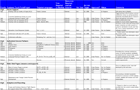 L10NExpert identified, studied and evaluated the main 16 customer touch-points and evaluated the ROI for each. The solution(s) that would yield the greatest ROI in the fastest time were selected.
- Through further reports and analysis we learned that 96% of the 46% non-US visitors attempted to use the Knowledge Base (one of the main customer touch-points) to find an answer to their questions before calling a company's support engineer at one of the 4 customer support centers.
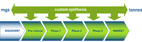 Our initial plan was delivered within the agreed upon time frame.
Result:
- L10NExpert proved to stakeholders and sponsors that the cost of hiring, training and deploying bi-lingual support engineer (TSE and SME) to 4 existing support centers around the world, was significantly superior to the cost of translating key knowledge base articles in all target languages. Localized articles would be delivered through a "self-service" internet-based mechanism. We identified the break-even point and calculated the savings realized through cost avoidance. Using very conservative assumptions, we were able to prove that a minimum of $1.560.000 would be saved in one year for localizing only 75 selected KB's in 10 languages.
-
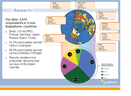 We developed a final plan and unveiled it to the senior executive and sponsors for final approval and budget.